
olomol
Drawing chemical structures, reactions and mechanisms, free in your browser
What olomol is
olomol is a free program for drawing chemical structures, reactions and curved-arrow mechanisms. It is made for chemistry education and for anyone who draws chemistry: lectures and slides, handouts, exercises, exams, theses and publications.
It runs entirely in the web browser. Nothing is installed and no account is needed. Drawings stay on your computer: in the browser and in files wherever you choose. Only a name or a molecule you look up on PubChem yourself is sent there. Once opened, olomol also works offline, and it can be installed as an app.
olomol is made at the Department of Physical Chemistry, Palacký University Olomouc, Czech Republic. It speaks Czech, English and German.
What it does
Mechanisms
- Lone pairs and unpaired electrons, counted from the chemistry; an atom without bonds as a Lewis symbol, with up to four unpaired electrons.
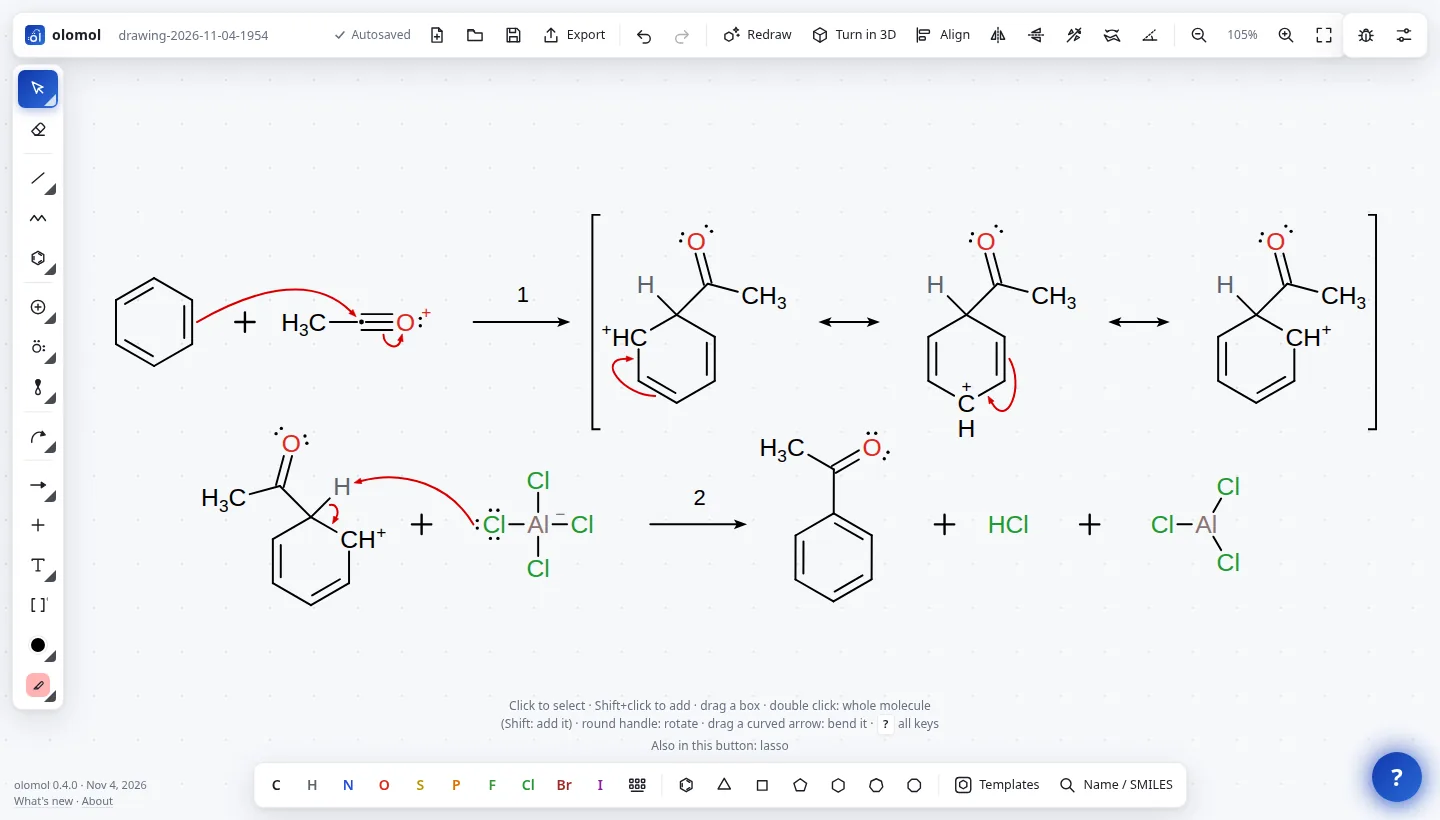
- Curved arrows and fishhooks tied to atoms, bonds and lone pairs; a fishhook dropped between two atoms makes the new bond (a curved arrow too, with Shift), so radicals combine as in textbooks. When the drawing moves, the arrows go with it.
- p, hybrid and s orbitals with their phases and overlap lines, such as the HOMO and LUMO of a Diels–Alder reaction.
- Resonance structures, transition states, brackets, charges and δ+ and δ−; an equilibrium lying to one side, a crossed arrow for a reaction that doesn't go.
Conformations
- Chairs that know their stereochemistry: from a template or drawn by hand, a chair is read as the stereoisomer it shows.
- A flat ring or a Haworth projection becomes a chair with one click, each group axial or equatorial as its wedge says; the ring flip makes it the other chair and, for a handout, draws both with ⇌; Turn a chair turns it a third of the way round, the groups staying axial or equatorial.
- Newman projections are real molecules: draw an E2 with curved arrows right in the projection, set the dihedral in the panel.
Chemistry it knows
- Molecular formula, molar and exact mass, elemental analysis, ions for HRMS.
- R/S and E/Z, IUPAC numbering with the reasons, SMILES, InChI and a PubChem link.
- Every redrawing, flip and 3D view is checked by RDKit, so the molecule and its R/S never change behind your back; when an edit of yours changes it, it warns you and marks the atom that doesn't fit.
Drawing
- Bonds including wedges, hashed wedges, wavy, dative and hydrogen bonds; chains and rings.
- Abbreviations (Ph, Boc, OMe) that can be drawn out and abbreviated again; isotopes (13C, D).
- Texts with formulas (H₂SO₄, Fe³⁺); reaction, equilibrium, resonance and retrosynthesis arrows with conditions and reagents above and below.
Templates and structures from names
- Rings, functional groups, chairs, Newman, Fischer and Haworth projections, complexes, amino acids, sugars, nucleobases, reagents and solvents.
- Search by a part: ?ester lists the templates with an ester.
- A structure from its name, SMILES or InChI (names are looked up in PubChem).
Layout and 3D
- Redraw offers several clean drawings to choose from, of whole molecules or only a selected part.
- Turn in 3D: turn a molecule or a complex with the mouse and draw it as you see it, with wedges that keep its R/S, E/Z and Λ/Δ; the conformation drawn stays (an axial group axial), and a stick model shows the real shape with every hydrogen.
- Metal complexes are worked out by a force field: porphyrins flat, chelates where they belong, Λ and Δ named.
- Align, space evenly, a grid and a reaction scheme in one row.
Files
- Saves KET (Ketcher opens it too); exports molfile, SDF, SMILES, InChI and XYZ (3D), and SVG and PNG pictures.
- A picture into Word, PowerPoint and Google Docs with Ctrl+Shift+C; a link that carries the whole drawing.
Getting started
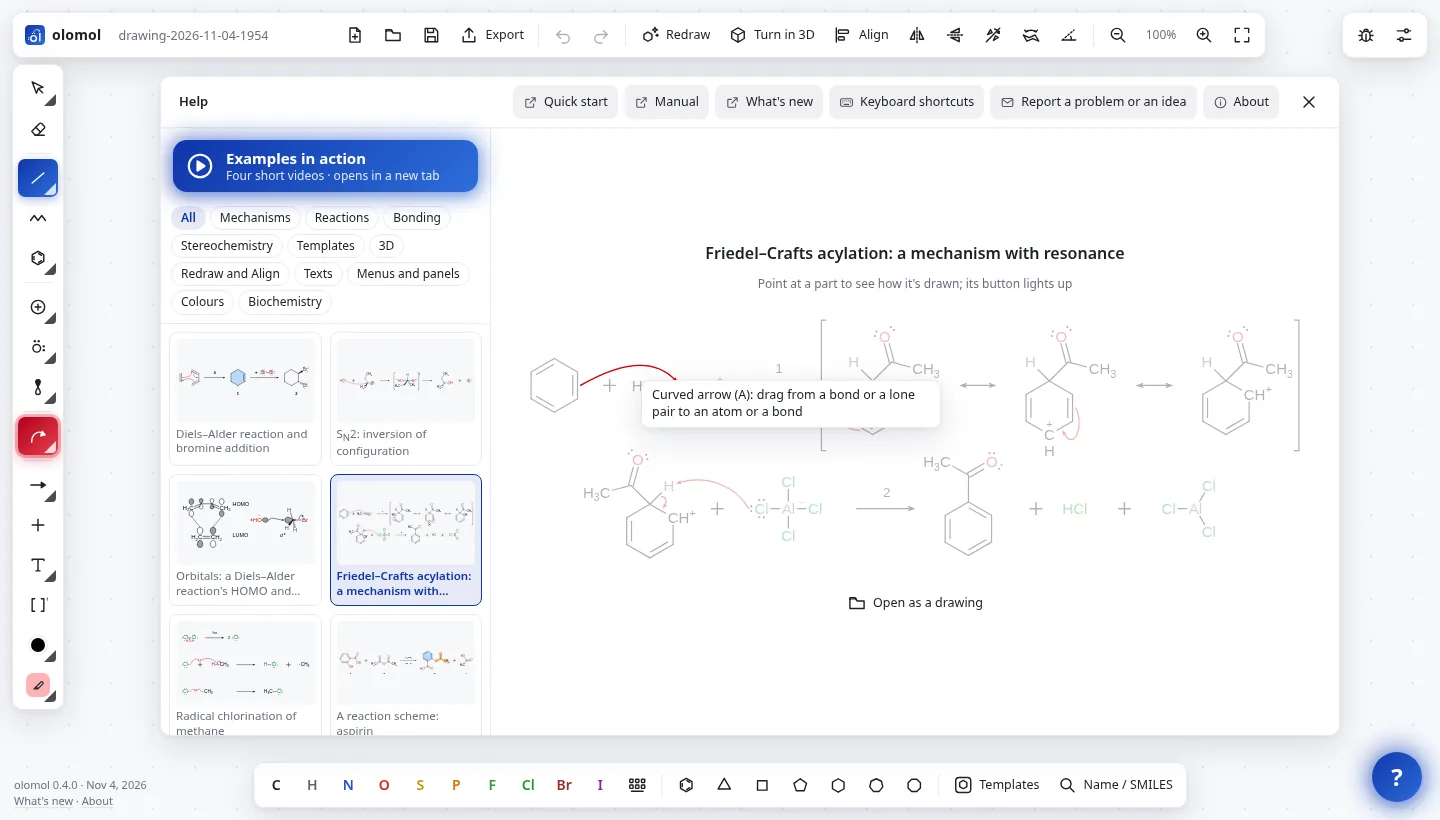
Open olomol and start drawing. The round ? button at the bottom right opens Help with the examples. Guides in PDF: the Quick start and the Manual.
Questions
Is olomol free?
Yes. olomol is free to use under the MIT License, for teaching, study, research and publications alike. There is no account, no paid version and no advertising.
Do I have to install it? Does it need the internet?
Nothing is installed: it runs in Chrome, Edge or Firefox on Windows, Mac or Linux. Once opened, it works offline too, and Chrome or Edge can install it as an app.
Where are my drawings kept?
On your computer. The browser keeps the drawing you are working on, and you save files wherever you choose. Nothing is sent anywhere, except a name or a molecule you look up on PubChem yourself.
Which files does it open and save?
It opens KET, molfile, SDF, SMILES, RXN, CML, XYZ and ChemDraw files (CDXML, CDX). It saves KET, which Ketcher opens too, and exports molfile, SDF, SMILES, InChI and XYZ, and pictures as SVG and PNG. Ctrl+Shift+C copies a picture straight into Word, PowerPoint or Google Docs.
Does it work with ChemDraw?
olomol opens ChemDraw's files (CDXML, CDX) with their abbreviations kept. Structures go to ChemDraw as a molfile or SDF, and pictures as SVG.
May I use the pictures in homework, theses and papers?
Yes, they are yours, with no watermark. If olomol helped, I'd be glad of a citation.
How do I cite olomol?
Salomon, J. olomol: drawing chemical structures, reactions and mechanisms [Computer software]. Zenodo. https://doi.org/10.5281/zenodo.24104909. Add the version you used; the About window gives the citation as text, BibTeX, RIS and CSL JSON.
Who makes it
olomol is written by Jan Salomon at the Department of Physical Chemistry, Palacký University Olomouc, with substantial help from Claude (Anthropic). Send problems and ideas with the bug button at the top right of the app, or to bugs@olomol.org.
Translations are welcome. If you would like olomol in your language, write to bugs@olomol.org: the app’s texts are one list of about a thousand short phrases, and translating them needs no programming.
olomol is free to use under the MIT License.
It is built on RDKit (BSD-3-Clause), Indigo by EPAM Systems (Apache 2.0), megane-rdkit (BSD-3-Clause; 3D structures) and OpenChemLib (BSD-3-Clause). Its KET format is the one of Ketcher. The libraries' licences.